
ESSAY: The Poison is the Policy
How a walk in the woods became a snapshot of empire
[This piece was originally published on Substack.]
In a vain attempt to escape the reality of navigating systemic failure at every turn on top of all the imperial fuckery being imposed upon the world—especially in the South West Asian North Africa (SWANA) region (commonly referred to as the Middle East), I took myself out to a regional park to commune with nature and harvest stinging nettles. As someone who struggles with a dysregulated immune system, stinging nettles are one of the few things I can utilize to alleviate certain persistent and debilitating symptoms.
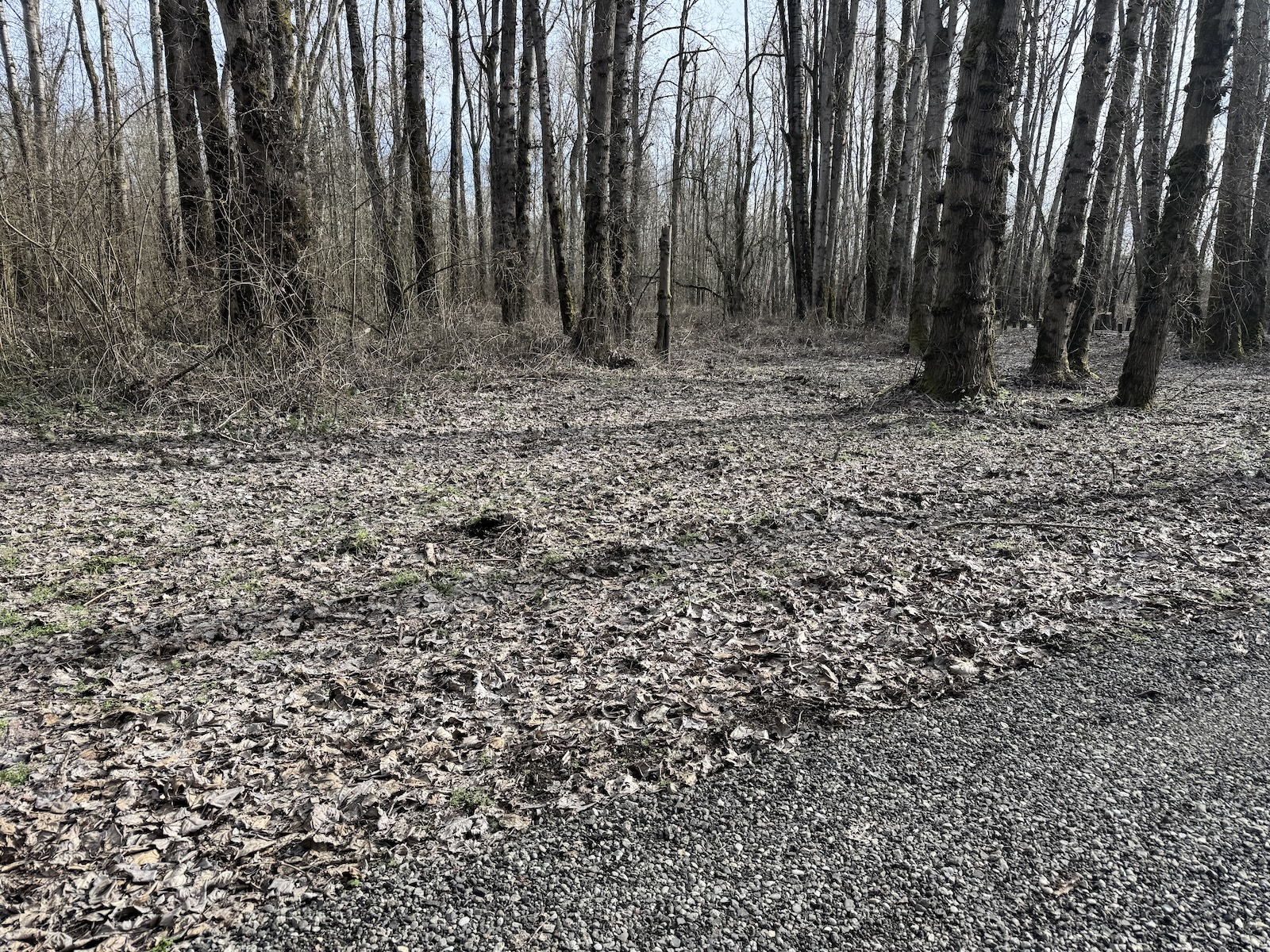
The gut punch I felt when I arrived to discover the park—Kelly Point Park in Portland, OR—looked like it had been napalmed. Where I expected bright green plant life to be emerging from the wet soil, I saw instead huge swaths of land where nothing was growing. It hadn’t been tilled or manually weeded—this could only be the result of chemical defoliation.
Just a year ago, I volunteered to plant trees in this area with two local groups, Climate Curious, and Friends of Trees. Along with over 70 volunteers, we planted over 300 trees and native plants, trying to restore areas that had become barren through commercial use in past years. That juxtaposition of community coming together to steward the natural world only for the parks department to blast the entire 105-acre park with glyphosate, also known as RoundUp, and possibly other chemicals isn’t just a metaphor of what it’s like to try to heal the land from abuse—it’s an illustration of systems of harm colliding with a dominion obsession.
Besides being a bummer for me personally, as this was a piece of self-care I would not have access to any longer, it’s bigger than me and my disappointment. Kelly Point Park is a riparian waterway, situated at the confluence of the Willamette and Columbia Rivers. The slow-moving water in the Columbia Slough provide a place where native Chinook and coho salmon and steelhead trout can rest. The park is home to countless wildlife, including turtles, salamanders, freshwater mussels, beavers, osprey, coyotes, bald eagles, deer, and more.
Glyphosate anywhere is bad news for all living things, not just weeds. When applied near waterways it’s next-level recklessness—it doesn’t just kill the blackberries. It gets into the soil biome, the water table, and the invertebrate populations that everything else depends on. Nuking the entire understory to get at blackberries is the most dominion-brained approach possible. There are integrated methods—goat grazing, repeated cutting, targeted removal, replanting with native competitors—but those require patience and relationship with the land, and that’s not how Portland’s agencies operate.
It is one small example of the harms done—to the environment, to animal life, to human life, to aquatic life, to plant life—that when unpacked, reveal it’s not such a small thing at all.
Microcosm, Meet Macrocosm
Standing in that dead patch of parkland, it’s tempting to think this is just a municipal land-management decision. But the chemicals sprayed here are part of a much larger, more intricate system.
On February 18, 2026, the President of the United States invoked the Defense Production Act—a Korean War–era emergency power—to mandate domestic production of glyphosate-based herbicides and elemental phosphorus. The White House called it a matter of national security. “Food security”, they said. We can’t leave our food supply vulnerable to hostile foreign actors. Sounds reasonable, right?
Ten days later, on February 28, the US and Israel launched coordinated strikes on Iran, killing Ayatollah Ali Khamenei (but only after double-tapping a girl’s school that left 175 people dead, most of them children under the age of 12). Iran retaliated, bombing Israel and US military bases in the SWANA region and shutting down The Strait of Hormuz. One-fifth of the world’s oil and nearly a third of global fertilizer exports flow through the strait.
Today, oil is above $100 a barrel. Insurers have canceled war risk coverage across the Persian Gulf. Global shipping giant Maersk suspended operations. And the UN released a report this morning warning that food and fertilizer prices are about to spike, hitting the world’s poorest countries hardest. Urea, ammonia, phosphates, sulfur—the inputs that keep global agriculture functioning—are sitting on tankers that can’t move.
They knew. The administration secured domestic herbicide and munitions supply ten days before starting a war that would sever the world’s fertilizer supply chain. That’s not preparation. That’s foreknowledge dressed as policy.
And the timing gets worse. The sole domestic producer of both elemental phosphorus and glyphosate is Bayer—the company that bought Monsanto and inherited tens of thousands of cancer lawsuits over Roundup.
One day before Trump’s executive order, Bayer proposed a $7.25 billion settlement for those claims. The Defense Production Act order doesn’t just prioritize production. It extends liability protections to domestic producers. “National security” became the legal shield a German chemical conglomerate needed to keep selling a known carcinogen without consequence.
Here’s the detail that should make your stomach turn: elemental phosphorus is a dual-use material. For agriculture, it’s a glyphosate precursor. For the military, it’s a component of smoke munitions, illumination rounds, and incendiary devices.
One executive order. Two supply chains. Bombs and herbicides—both designed to destroy life, both secured under one signature—while the rest of the world’s fertilizer supply was about to be cut off at the throat.
We are not collateral damage. We are the target.
This is what empire does. It doesn’t stumble into crisis. It manufactures the conditions, pre-positions the profits, and lets everyone else absorb the shock. American farmers get glyphosate. Bayer gets immunity. Defense contractors get phosphorus. And the countries that depend on fertilizer shipments through Hormuz—the ones already food-insecure, already destabilized—get the bill.
You and me? We get the cancer. If we’re “lucky” we’ll only get the metabolic syndrome, reproductive issues, skin and eye irritation, and gastrointestinal issues. If we’re not so lucky we’re at risk for non-Hodgkin lymphoma, endocrine disruption, kidney and liver damage, and developmental issues.
Empire doesn’t need you to understand what it’s doing. It only needs you to absorb the costs. The glyphosate in the soil, the phosphorus in the bomb, the cancer in the body—these aren’t side effects. They’re the product. The macrocosm and the microcosm are not metaphors for each other. They are the same system, operating at different scales, extracting from the same source: living beings.
I walked into that forest looking for something to heal me. What I found was the same thing that’s been making me sick all along—the same logic, the same impunity, the same contempt for living systems that don’t produce profit. Empire doesn’t stumble. It plans. Even when it seems reactive—perhaps especially when it positions as reactive—it plans.
We are not collateral damage. We are the target.
This piece was originally published on Substack. If you enjoy this writing, please consider subscribing to my channel.